Lateral under a Brookside patio
Collapsed clay lateral under brick walk — HDD preserves patio and hedge open trench would remove.
Tulsa, OK · Tulsa County
No-dig sewer and water boring under Tulsa patios and berms — lateral replacement when sandstone and tree roots break PVC along Brookside and Riverside.
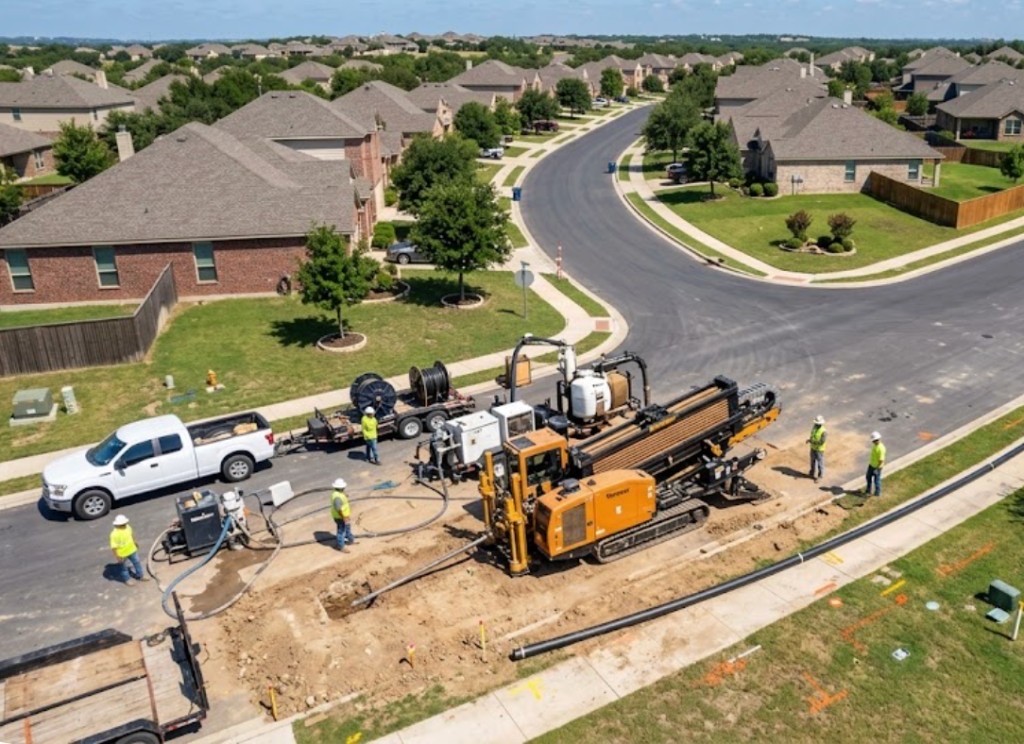
Sewer and water line boring in Tulsa fixes laterals that fail under brick patios, side-yard gates, and bermuda lawns along Peoria and Riverside — open-cut on those blocks destroys hardscape worth more than the pipe. Compact pits at cleanout and tap steer HDPE through claystone and alluvium.
Broken Arrow and Bixby growth corridors see the same lateral age curve — camera inspection confirms breaks under circular drives after dry summers shrink clay. Directional boring in Tulsa County suburbs spikes on city notices and insurance leak claims.
Municipal lead rehab on older Midtown streets bundles shallow laterals with main work — tap rules, pressure test, and sod follow City of Tulsa detail. Multi-lot infill uses trenchless to keep streets passable.
Real Tulsa County angles — not generic statewide copy.
Collapsed clay lateral under brick walk — HDD preserves patio and hedge open trench would remove.
Heaved PVC under pavers — bore avoids full drive removal; meter tie may need small cut.
City notice on aging lead — trenchless keeps common-area sod; tap rules per address.
Cannot lose stalls to trench — night tie-in to city main when traffic is light.
Tulsa sewer and water bores start with camera and locate — pits sized for sandstone or wet bank soils. Pipe ties per city or MUD rules; test and restoration follow local detail. Post-storm saturated banks may delay pits — communicated before mobilization.
Tulsa County mixes sandstone, siltstone, and claystone with sandy Arkansas River alluvium — variable bearing and groundwater along the river corridor.
Tulsa bores encounter Pennsylvanian sandstone and shale east and south of downtown, with softer alluvium and sand in Arkansas River bottoms. River-adjacent shots risk frac-out into the water table without proper mud weight. West toward Sand Springs and Sapulpa, claystone dominates with intermittent rock lenses that slow penetration without correct tooling. We pull geotech when city records are thin — especially on floodplain and levee approaches.
Arkansas River humidity, spring tornado season, and summer heat shape Tulsa bore schedules — lightning holds and post-storm saturated banks are planned into quotes.
Spring tornado season and Arkansas River flood stages are Tulsa's biggest calendar variables. Saturated river banks delay entry work; lightning shuts down rigs during severe weather. Summer humidity affects crew safety and fluid performance on long pulls along the IDL. We schedule around known wet seasons instead of forcing bores into unstable banks.
City of Tulsa Engineering Services, Tulsa County ROW, ODOT District 1, Arkansas River floodplain, and Creek Turnpike Authority permits appear on many metro bores.
City of Tulsa permits govern street cuts, drive removals, and floodplain work along the Arkansas River. Tulsa County handles ROW outside city limits toward Broken Arrow and Owasso. ODOT District 1 controls I-44 and US-75 state bores — MOT and night windows are common. Creek Turnpike Authority adds a layer on turnpike frontage. Railroad agreements on BNSF lines through the industrial corridor require separate timelines from 811.
Patios, pavers, and river-adjacent landscaping cost more to replace than trench in open rear easement — boring wins on restoration math. Empty lots may still trench on price.
Length, depth, tap fees, rock, paver restoration, and access for rig staging.
You share plans or describe the problem; we confirm alignment, depth, access, and which trenchless method fits Oklahoma soils.
Oklahoma One-Call ticket filed; two business days minimum before pits open unless your permit path differs. We pothole where marks conflict.
Bore plan, ODOT or city ROW permits, railroad agreements, and crossing engineering when the path leaves private property.
Compact spread for tight Edmond lots; larger HDD for I-35 or I-40 relocations — matched to length and diameter.
Steered pilot on design line, ream passes sized for your pipe or casing, fluid program tuned for clay or sand lenses.
HDPE fusion, steel casing, or multi-duct bundle pulled with tension and bend-radius monitoring.
Pressure test, mandrel, or survey records for owners, inspectors, and operators as spec requires.
Compact pits, replace sod or hardscape per scope, leave 811 ticket and locate map in your project file.
Often yes when pits fit at cleanout and tap — confirmed after camera and locate, not from phone description alone.
Varies by utility — quote states owner, city, or contractor responsibility.
Many driveway shots finish in one to two days after valid locates; rock, permits, or wet banks extend the window.
Sometimes — alignment must clear pool plumbing; site walk determines feasibility.
24/7 — Emergency dispatch statewide. Tell us entry, exit, pipe size, and county — a bore specialist calls back with cost drivers, not a flat rate.
Scope your bore path
Step 1 of 2 — path, pipe, and city first