Emergency line, same number
Line strike, main break, or permit window closing — dispatch answers 24/7 when locates and safe access allow.
Oklahoma statewide
Telecom and fiber conduit boring places HDPE innerduct underground for carrier backhaul, enterprise rings, and 5G small-cell feeds — without trenching suburban streets or industrial frontage.
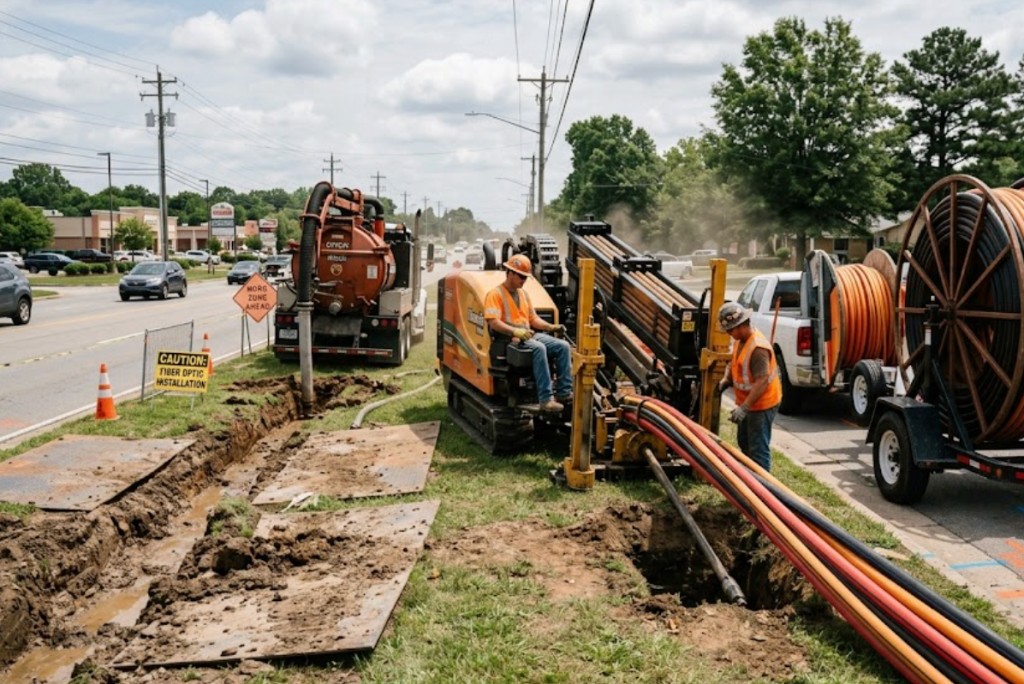
Telecom and fiber conduit boring places HDPE innerduct underground for carrier backhaul, enterprise rings, and 5G small-cell feeds — without trenching suburban streets or industrial frontage.
Rigs drill vault-to-vault or handhole-to-cabinet paths. Multi-duct bundles pull when bend radius allows. Profiles respect OG&E and gas separation per locate maps and code.
1.25 inch through 6 inch HDPE innerduct; steel casing where railroad or ODOT templates require.
Lot-to-lot drops to backbone segments along state highway frontage.
Fiber schedules die on HOA and city restoration fights — boring keeps corridors moving.
Suburban OKC and Broken Arrow ROW stacks power, gas, and irrigation in the first few feet — pothole programs are standard.
Duct count, length, hardscape at vaults, traffic control, and city franchise fees.
Get a Free Estimate →Shrink-swell clay, OG&E congestion, and ROW permits change the math — we scope before we mobilize.
Line strike, main break, or permit window closing — dispatch answers 24/7 when locates and safe access allow.
Send path, diameter, and county — we explain footage, rock, traffic control, and tap fees as drivers, not a menu price.
Oklahoma dig law, pothole conflicts, and expired tickets stop work — we document locates for commercial and municipal files.
Finished berms, brick walks, and tenant parking stay largely intact when HDD or casing fits the alignment.
Engineered from duct OD, wall thickness, and reamed diameter — not overloaded to save ream cost.
Short curb-to-pole bores are common when power and fiber paths are coordinated.
Only with valid locates, separation per code, and sometimes parallel clearance agreements.
HDD uses a steerable drill head to create an underground path, then pulls pipe or conduit through without a continuous surface trench. It is the standard way to cross driveways, parking lots, highways, and waterways when restoration costs matter.
Quotes depend on footage, pipe size, red clay or rock, groundwater, traffic control, and how many utilities share the corridor — we do not publish a per-foot rate. Send your alignment and we will break down the cost drivers on a free estimate.
24/7 — Emergency dispatch statewide — (512) 838-3643
Scope your bore path
Step 1 of 2 — path, pipe, and city first