BNSF casing under a Midwest City industrial spur
Railroad template requires steel casing with internal carrier and grouting. Drive pit shoring and flagging windows set the calendar — not the jack footage alone.
Oklahoma City, OK · Oklahoma County
Jack and bore casing under OKC rail spurs and levee approaches — straight pushes when BNSF templates and ODOT specs require steel carrier protection in red clay.
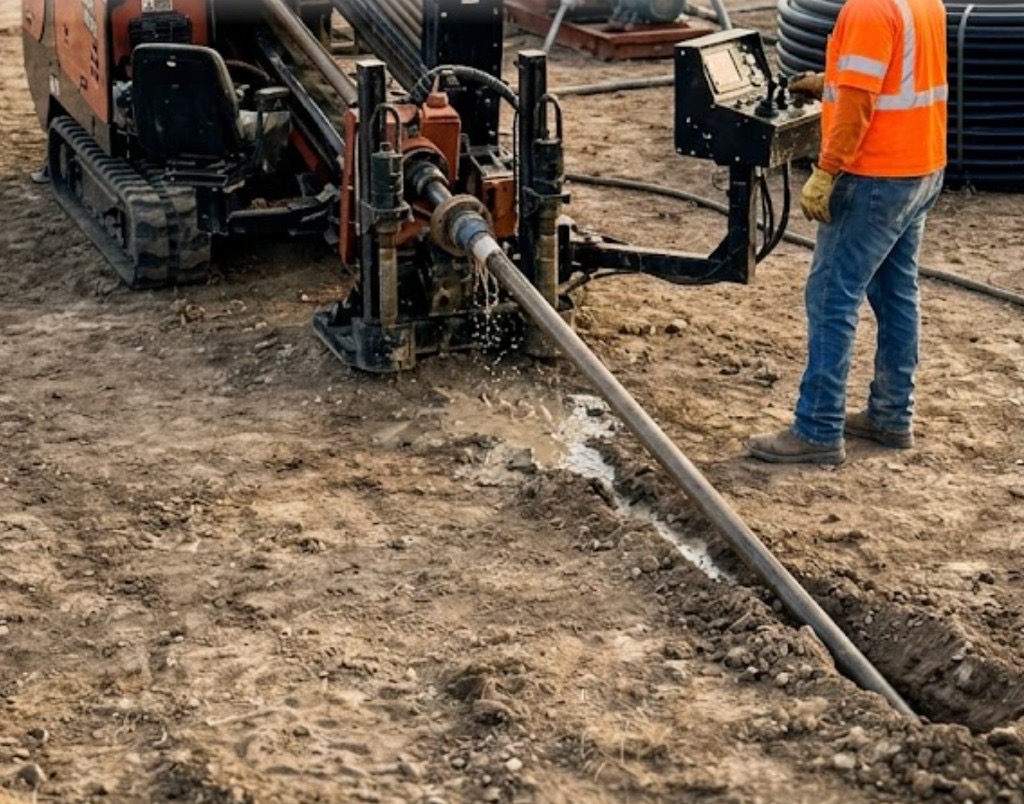
Auger boring in Oklahoma City fits railroad agreements, storm outfall approaches, and straight alignments under building footprints where a steerable path is unnecessary but casing is mandatory. Drive and reception pits are shored for Oklahoma County clay; casing segments jack on line and grade while spoil is removed mechanically.
BNSF and Union Pacific windows along the I-35 industrial belt and North Canadian levees often specify jack and bore with welded casing inspection — HDD may be ruled out by template or owner spec. Directional Boring Oklahoma scopes pit dewatering, groundwater handling, and flagging holds that can exceed the jack duration.
Directional drilling in Oklahoma City handles curves and long HDPE pulls; auger bore wins when the engineer draws a straight casing run under a highway approach slab or rail embankment. We align method with your plan set before quoting — not after the rig is on site.
Real Oklahoma County angles — not generic statewide copy.
Railroad template requires steel casing with internal carrier and grouting. Drive pit shoring and flagging windows set the calendar — not the jack footage alone.
Straight RCP push under embankment fill where open cut would breach slope stability. Groundwater handling and dewatering are scoped with the levee district.
Short rigid carrier protection under mixed-use hardscape where HDD profile tolerance is tighter than jack-and-bore grade control allows on a 60-foot push.
ODOT detail calls for shared casing with dividers for future telecom and electric — auger bore sets the shell; internal pulls follow inspection milestones.
Auger bore in OKC starts with pit layout on survey line — locates cleared, shoring designed for clay sidewalls, and dewatering if groundwater enters the drive pit. Casing segments advance with a rotating head; welding inspection and railroad flagging follow owner templates. Reception pit exposes the face for carrier install and grout per agency detail.
Oklahoma County red clay, sandy loam, and variable groundwater dominate most residential corridors — shrink-swell clay complicates open trenching and restoration.
Most OKC bores encounter reddish-brown clay with shrink-swell behavior, intermittent sand lenses, and seasonal groundwater rise. Shallow groundwater raises buoyancy risk on long HDPE pulls — we size ream stages and pullback plans accordingly. West toward Yukon and El Reno, sandier soils reduce stick-slip but increase bore collapse risk without proper drilling fluid. South toward Moore and Norman, tighter clay can slow penetration without the right bit selection. We do not assume a single soil model for all of Oklahoma County.
Tornado alley weather, spring thunderstorms, and summer heat push OKC crews to plan mud programs, lightning holds, and schedule buffers around severe weather.
Spring thunderstorms and tornado season are the biggest calendar risks in OKC. Saturated clay softens ROW and can delay entry pit work for days. Summer heat affects crew safety and drilling fluid performance on long pulls. We plan around known wet seasons and communicate when a bore should wait for drier conditions rather than risk a frac-out along a river bank.
City of Oklahoma City Public Works, Oklahoma County ROW, ODOT District 4, and North Canadian floodplain rules apply on many bore paths.
Inside Oklahoma City limits, street cuts, driveway removals, and floodplain work may need Public Works permits. Oklahoma County projects outside city limits follow county ROW standards. ODOT District 4 controls state highway bores on I-35, I-40, and I-44 — expect traffic control plans and sometimes night-only drilling windows. Railroad crossings require separate agreements with BNSF or Union Pacific. HOA communities in Edmond, Quail Creek, and Gaillardia may require landscape restoration bonds — trenchless reduces but does not eliminate those conversations.
Jack and bore keeps rail and highway pavement width intact on short straight obstacles. Curved HDPE sewer pulls without casing usually shift to HDD. Open-cut across a BNSF ROW is rarely permitted compared to cased bore templates.
Casing size, drive length, pit depth, groundwater, rail or highway flagging, and welding inspection.
You share plans or describe the problem; we confirm alignment, depth, access, and which trenchless method fits Oklahoma soils.
Oklahoma One-Call ticket filed; two business days minimum before pits open unless your permit path differs. We pothole where marks conflict.
Bore plan, ODOT or city ROW permits, railroad agreements, and crossing engineering when the path leaves private property.
Compact spread for tight Edmond lots; larger HDD for I-35 or I-40 relocations — matched to length and diameter.
Steered pilot on design line, ream passes sized for your pipe or casing, fluid program tuned for clay or sand lenses.
HDPE fusion, steel casing, or multi-duct bundle pulled with tension and bend-radius monitoring.
Pressure test, mandrel, or survey records for owners, inspectors, and operators as spec requires.
Compact pits, replace sod or hardscape per scope, leave 811 ticket and locate map in your project file.
Casing templates and straight alignments favor auger bore. Curved paths or long HDPE without casing favor HDD. We review your engineer's method note before quoting.
Physical jacking may finish in days; BNSF or UP agreements and inspection holds often drive weeks-to-months lead. Quote includes flagging scope.
Running sand and cobbles without dewatering can stall progress. Test pits and geotech reduce mid-job surprises in variable fill near the river.
Yes — when plans specify casing and gravity grade on a straight push. Microtunneling may apply on large trunk lines with tighter tolerance.
24/7 — Emergency dispatch statewide. Tell us entry, exit, pipe size, and county — a bore specialist calls back with cost drivers, not a flat rate.
Scope your bore path
Step 1 of 2 — path, pipe, and city first