Lateral under a Hall Park berm and irrigation
Heaved PVC under sprinkler heads — HDD preserves berm profile open trench would strip and rebuild.
Norman, OK · Cleveland County
Steerable HDD under Norman berms, campus-area parking, and I-35 frontage — mud programs for Cleveland County shrink-swell clay and Garber sandstone lenses.
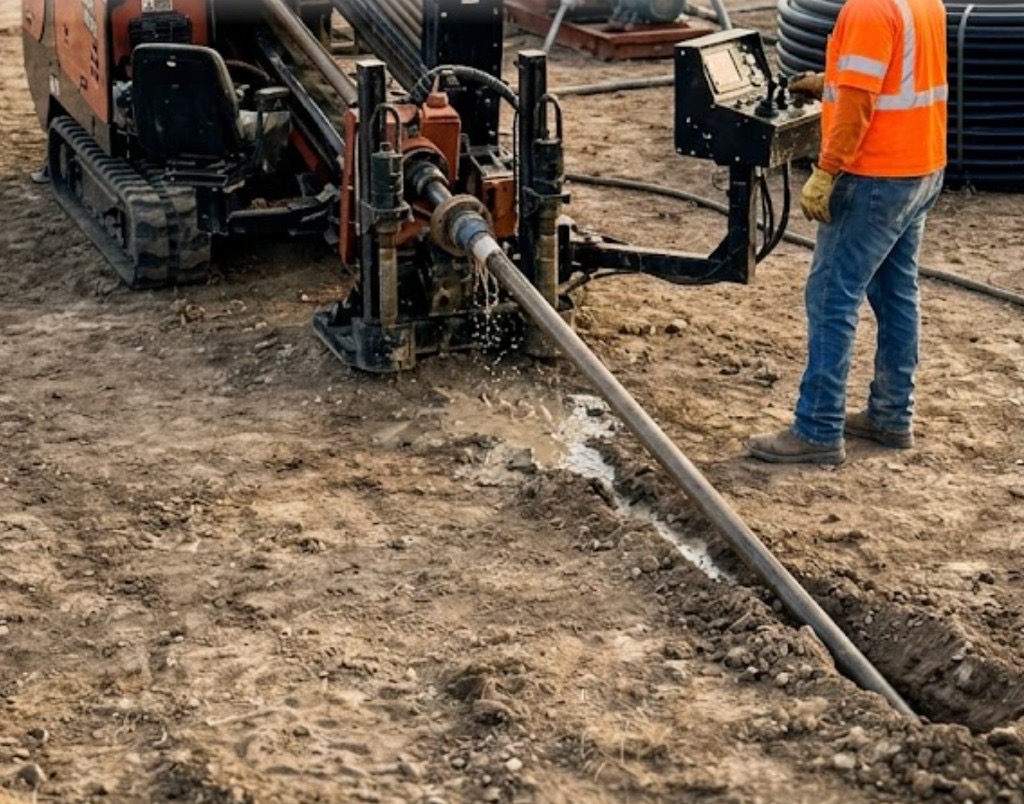
Horizontal directional drilling in Norman targets east-side subdivisions where clay heave snapped PVC laterals under berms and the only driveway approach to the garage. Landlords on Legacy Trail and Hall Park need replacement without rebuilding irrigation and sod between tenants — steerable pulls from cleanout to tap keep restoration scoped to two pits.
Directional boring in Norman on West Main and Lindsey corridors serves TI work that cannot trench across retail parking after pavers are down. OG&E secondary, city water, and decades of campus-adjacent rebuilds crowd shallow ROW — One-Call and hand holes at paint conflicts come before rig day on Porter and Main arterials.
Directional drilling in Norman along I-35 adds ODOT MOT and night windows to standard locate rules. Moore-border addresses share Cleveland County clay but may fall under different tap authorities — quotes name who coordinates the city connection before steel mobilizes.
Real Cleveland County angles — not generic statewide copy.
Heaved PVC under sprinkler heads — HDD preserves berm profile open trench would strip and rebuild.
Campus-area TI after paving — vault-to-vault bore keeps stalls open except at tie-ins.
Shallow OG&E and gas on highway feeder — remark tickets and potholes before steering.
Longer shot with MOT — sandstone lens may slow penetration; mud program adjusted on site walk.
Norman HDD confirms survey and locate paint — two business days minimum on One-Call, longer on I-35 ROW. Pits shored for shrink-swell clay; mud weight rises near Lake Thunderbird approaches. Pilot, ream, and pullback monitored when sandstone lenses appear south of campus or groundwater lifts buoyancy on long HDPE.
Cleveland County red clay and Garber sandstone lenses dominate — shrink-swell heaves break PVC laterals under slabs and berms common in 1990s subdivisions.
Norman bores mostly hit reddish shrink-swell clay with Garber sandstone lenses south and east toward Noble. Sandstone slows penetration without correct bit and mud selection. Near Lake Thunderbird, higher groundwater raises buoyancy risk on long HDPE pulls — ream stages and pullback tension are planned accordingly. East Norman fill in newer subdivisions is often homogenous clay — frac-out risk rises if mud weight is wrong after heavy rain.
Tornado alley exposure, spring hail, and red-clay shrink-swell define Norman schedules — campus event calendars and game-day traffic add MOT complexity on some arterials.
Spring tornado season and OU event traffic complicate Norman calendars — saturated clay after storms softens ROW; game-day arterials may restrict lane closure windows. Summer heat affects crew safety on long I-35 pulls. We communicate when weather or campus events should shift bore dates.
City of Norman Engineering, Cleveland County ROW, ODOT I-35 corridor permits, and University-adjacent coordination on select routes.
City of Norman permits street cuts and driveway removals inside city limits. Cleveland County ROW applies toward the Moore border and rural approaches. ODOT controls I-35 bores — expect MOT plans. Properties near campus may have university or institutional coordination on certain corridors — scoped per address, not assumed globally.
Open-cut on east Norman berms and West Main hardscape often costs more in sod and business interruption than bore. HDD wins on congested campus corridors — open rear easement on rural Cleveland County may still trench on price.
Footage, diameter, clay versus rock, dewatering, traffic control, permit fees, utility density, and rig class — quoted as drivers, not a menu price.
You share plans or describe the problem; we confirm alignment, depth, access, and which trenchless method fits Oklahoma soils.
Oklahoma One-Call ticket filed; two business days minimum before pits open unless your permit path differs. We pothole where marks conflict.
Bore plan, ODOT or city ROW permits, railroad agreements, and crossing engineering when the path leaves private property.
Compact spread for tight Edmond lots; larger HDD for I-35 or I-40 relocations — matched to length and diameter.
Steered pilot on design line, ream passes sized for your pipe or casing, fluid program tuned for clay or sand lenses.
HDPE fusion, steel casing, or multi-duct bundle pulled with tension and bend-radius monitoring.
Pressure test, mandrel, or survey records for owners, inspectors, and operators as spec requires.
Compact pits, replace sod or hardscape per scope, leave 811 ticket and locate map in your project file.
Norman HDD follows length, diameter, clay or sandstone, utilities, and restoration — not a flat rate. East Norman lateral, West Main duct, and I-35 crossing use different spreads. Send alignment for a free estimate.
Yes — shrink-swell clay is default. Mud program and pullback manage wet-season softness and heave risk.
Two business days minimum after One-Call; Lindsey and Main corridors may need remark and pothole time.
Yes — Cleveland County mobilization; tap rules may differ by city limit.
Often yes with offset pits — camera and locate confirm; tie-in may need small access cut.
24/7 — Emergency dispatch statewide. Tell us entry, exit, pipe size, and county — a bore specialist calls back with cost drivers, not a flat rate.
Scope your bore path
Step 1 of 2 — path, pipe, and city first